Disclosure: This comparison is published by Tomako. We have tried to separate verifiable product facts from our judgment, link to primary sources, and state where Copy.ai is the stronger choice. Pricing and packaging were checked on July 30, 2026.
Tomako and Copy.ai now use similar language—AI, workflows, and go-to-market—but they are built around different operating assumptions.
Copy.ai began as an AI writing product and now positions itself as a GTM AI platform spanning sales, marketing, and operations. In October 2025, Fullcast acquired Copy.ai, joining Copy.ai's execution layer with Fullcast's RevOps planning system. That makes enterprise revenue operations—not solo-founder launch work—the clearest center of gravity. See the official acquisition announcement.
Tomako is designed around a different customer: an indie developer, early founder, or small team that needs reusable product context, reviewable launch material, and guided growth work without assembling an enterprise stack.
The answer at a glance
| Decision | Better fit | Why |
|---|---|---|
| Solo founder preparing a launch | Tomako | Product context, launch assets, checklists, and indie-scale pricing |
| Small team coordinating early growth | Tomako | Work is organized around a product and concrete growth activities |
| Enterprise outbound, ABM, or RevOps | Copy.ai | Deeper sales workflows, seats, credits, integrations, and Fullcast alignment |
| Custom workflows across a mature GTM organization | Copy.ai | Workflow infrastructure and enterprise implementation support |
| Using Claude, ChatGPT, Cursor, or Codex with shared product context | Tomako | A direct MCP connection is part of the product model |
| Free-form multi-model chat for a team | Copy.ai Chat | Public Chat plan includes OpenAI, Anthropic, and Gemini access |
Neither product is universally better. The useful question is: which operating model matches the work you actually need to do?
Current public pricing
| Public plan | Current list price | What the vendor emphasizes |
|---|---|---|
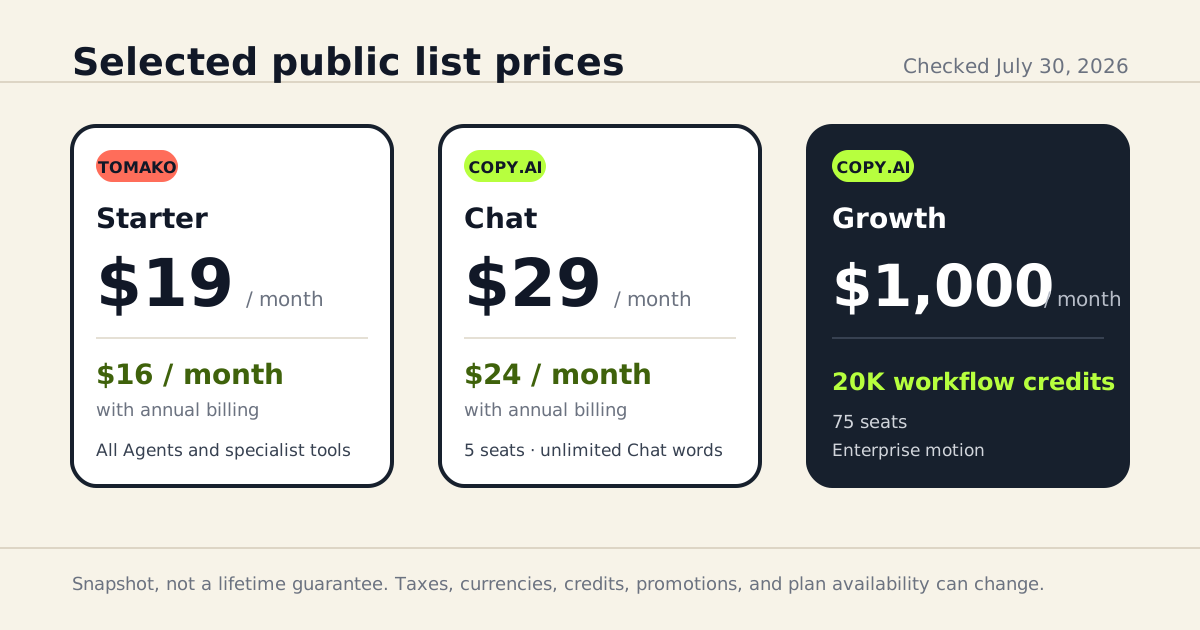
| Tomako Starter | $19 monthly; $16/month with annual billing | One product, all Agents and specialist tools |
| Copy.ai Chat | $29 monthly; $24/month with annual billing | 5 seats, unlimited Chat words, multi-model access |
| Copy.ai Growth | $1,000 monthly | 75 seats and 20,000 workflow credits per month |
| Copy.ai Enterprise | Custom | Implementation, API access, integrations, security, and support |
These are not equivalent packages. Copy.ai Chat is primarily a chat product; Copy.ai Growth is an organizational workflow plan. Tomako Starter includes its specialist tools but has materially lower usage capacity than higher Tomako plans.
The fairest conclusion is not “Tomako is 13 times cheaper.” It is this: Tomako offers an indie-scale entry point, while Copy.ai's workflow-heavy offering is packaged for a much larger organization. Always verify the live Tomako pricing and Copy.ai pricing before purchasing.
What Copy.ai is strongest at
Copy.ai is strongest when go-to-market work already spans several functions and systems.
Enterprise workflow automation
Its workflow model can connect research, content generation, lead processing, account intelligence, CRM enrichment, and sales actions. The public pricing page also describes API access, bulk workflow runs, 20+ integrations, customizable workflows, guided implementation, and enterprise security.
Sales and revenue operations
Copy.ai's product navigation is organized around prospecting, inbound lead processing, deal coaching, account-based marketing, and operations. Fullcast adds planning, territories, quotas, and compensation context. That is a meaningful advantage for a company with an existing sales organization.
Multi-model team chat
The Chat plan includes OpenAI, Anthropic, and Gemini models, five seats, unlimited words, and unlimited chat projects. A small team that mainly needs a shared AI chat workspace may prefer that straightforward package.
Where Copy.ai is a weaker fit for an indie builder
The issue is not that Copy.ai lacks capability. It is that an indie founder may not need the organizational layer it is designed to serve:
- Revenue planning and seat counts can be irrelevant when one person owns product, marketing, and support.
- Chat does not automatically become a launch plan, a reviewed asset set, or a maintained product context.
- The step from a $29 Chat plan to the $1,000 public Growth plan is a large packaging gap for a solo operator who specifically wants workflow credits.
What Tomako is strongest at
Tomako starts from the product and the builder's immediate growth goal.
Reusable product context
A URL, repository, or manual brief can become Product Context that later naming, content, launch, and growth work can reuse. This reduces the repeated “paste your product description again” loop common in general-purpose AI tools.
Indie launch and growth work
Tomako's public site currently describes:
- 30+ GTM Agents and skills
- 100+ launch assets and review checks
- 33 ToolSpec-backed workflows
- support for Product Hunt, app-store, community, social, and search deliverables
- an MCP connection for Claude, ChatGPT, Cursor, Codex, and other compatible clients
Those claims are visible on the Tomako product page. The emphasis is on reviewable deliverables and next actions, not enterprise pipeline administration.
Lower entry price
Starter is listed at $19 monthly or $16/month with annual billing. The public plan includes all Agents and specialist tools, with usage and product limits that increase across higher plans.
Where Tomako is weaker
Tomako is newer and should not be presented as a complete replacement for Copy.ai:
- It does not offer the same enterprise RevOps depth, territory planning, or ABM infrastructure.
- Its third-party integration footprint is smaller.
- Some dashboard, Business Updates, and Growth Signals capabilities are explicitly marked coming soon on the public pricing section.
- It has less independent user evidence and a smaller ecosystem.
If your purchase depends on a specific integration or a not-yet-shipped feature, verify it before subscribing.
Capability comparison
| Capability | Tomako | Copy.ai |
|---|---|---|
| Primary audience | Indie builders, early founders, small teams | Sales, marketing, operations, and enterprise GTM teams |
| Product context | Central to the workflow | Infobase, Brand Voice, tables, and organizational data |
| Launch assets and checklists | Core product focus | Possible through chat/workflows, not the primary product frame |
| Sales pipeline and ABM | Limited compared with enterprise platforms | Strong focus |
| Workflow model | Predefined, task-oriented ToolSpec workflows | Customizable organizational workflows and workflow credits |
| AI-tool connection | Direct MCP endpoint | API and GTM-system integrations on higher tiers |
| Multi-model chat | Not the main value proposition | Included in Chat plan |
| Enterprise implementation | Limited | Guided implementation and designated support |
| Public starting price | $19 monthly | $29 monthly for Chat |
Choose Tomako when
- You are one person or a small team taking a product from idea to launch and early growth.
- You want product facts, audience, positioning, and channel requirements to stay connected.
- You need checklists, draft assets, and review steps more than a custom enterprise workflow builder.
- You want compatible AI tools to access the same product context through MCP.
- You are comfortable with a newer product and will verify which capabilities are live.
Choose Copy.ai when
- You run an established B2B sales or marketing organization.
- You need outbound, ABM, lead processing, deal coaching, or CRM enrichment.
- You have several GTM roles and want shared workflows to codify team processes.
- You need enterprise security, implementation support, API access, and a larger integration catalog.
- The Fullcast plan-to-pay direction fits your revenue operations model.
Verdict
For the narrow audience in this article—indie developers and solo founders—Tomako is the more coherent fit. Its product model, scope, and pricing start from the reality of one builder managing the whole launch.
Copy.ai is the stronger choice for enterprise sales and RevOps. Calling it a bad indie tool would miss the point; it is solving a larger organizational problem.
The decision becomes simple:
Choose Tomako when your bottleneck is turning one product's context into launch and growth work. Choose Copy.ai when your bottleneck is coordinating a mature GTM organization.
Frequently asked questions
Can Tomako replace Copy.ai for an enterprise sales team?
No. Tomako does not currently match Copy.ai and Fullcast on enterprise revenue planning, ABM, workflow credits, or implementation support.
Does Copy.ai still have an Advanced plan at $249?
The current public pricing page we checked does not list that plan. It lists Chat at $29/month, Growth at $1,000/month, Expansion at $2,000/month, Scale at $3,000/month, and custom Enterprise. Packaging can change, so use the live pricing page as the source of truth.
Which platform is better for content marketing?
It depends on the operating context. Copy.ai can generate and automate content at organizational scale. Tomako is more tightly framed around an indie product's reusable context, launch channels, and reviewable deliverables. We do not claim that either product automatically produces publish-ready content without human review.
Can the two products be used together?
Yes. A team could use Tomako for product-context-led launch work and Copy.ai for enterprise sales or content workflows. The trade-off is cost and overlapping AI functionality.
Sources and review notes
- Tomako product and pricing page
- Copy.ai public pricing
- Fullcast acquires Copy.ai — official announcement
- Copy.ai pricing overview
This page was reviewed on July 30, 2026. Product availability, limits, pricing, and packaging may change.