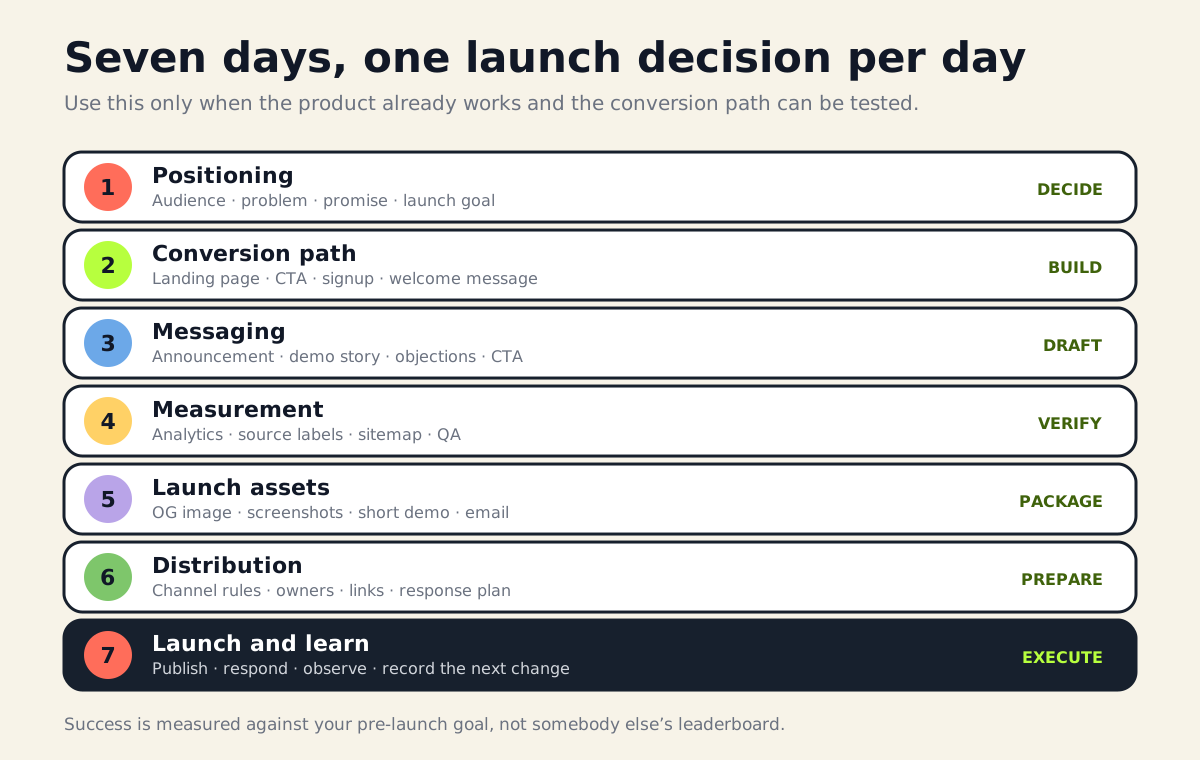
A seven-day launch is a coordination sprint, not a product-development schedule.
Use this plan when you already have:
- a product or beta that completes its core job;
- a public URL or store listing that can be tested;
- one clear conversion action, such as starting a trial, joining a waitlist, downloading, or booking a call;
- enough time to respond to users during launch week.
If any of those are missing, use the checklist as a 14- to 21-day plan instead. Compressing unresolved product and positioning work into launch week usually creates noise, not momentum.
Before day one: define success
Pick one primary launch outcome and two supporting signals.
| Launch type | Primary outcome | Supporting signals |
|---|---|---|
| Waitlist | Qualified signups | Landing-page conversion; replies |
| Beta | Activated testers | First core action; feedback completion |
| Paid product | Purchases or trials | Checkout starts; activation |
| Community launch | Relevant conversations | Profile visits; qualified follow-ups |
| Product Hunt | Product visits or signups | Comments; feedback; activation |
Avoid borrowed benchmarks such as “a good launch gets 500 signups.” Audience size, price, category, distribution, and product maturity change the denominator. A launch is successful when it produces the outcome and learning you chose in advance.
Day 1: positioning and launch goal
Goal: decide what the launch is about and who should care.
Tasks
- Write one audience sentence: “This is for ___ who currently ___.”
- Write one problem sentence using the audience's language.
- Write one promise that the product can demonstrate today.
- Choose the primary conversion action.
- Record the claim you are not ready to make.
Use competitor pages, recent support conversations, search results, and user interviews as evidence. Google Trends can compare directional search interest, but relative search interest is not market validation.
Day 1 exit check
- One target audience is named.
- The current problem is observable.
- The product promise is demonstrable.
- One primary launch metric is selected.
- Unsupported claims are excluded.
Day 2: landing page and conversion path
Goal: make the path from visit to next step work end to end.
Your page needs five things:
- Clear headline — what the product helps the visitor do.
- Concrete evidence — screenshot, short demo, example output, or a credible user quote.
- Relevant detail — the two or three capabilities needed to understand the result.
- Boundary — what the product does not do yet.
- One CTA — the exact next action.
Then test the whole path:
- submit the form on desktop and mobile;
- confirm the success state;
- confirm the email or account arrives;
- verify links, redirects, and legal pages;
- test with a real address that is not the admin account.
Do not publish invented testimonials or placeholder logos. “Early beta” is more credible than false social proof.
Day 2 exit check
- Landing page works on a 390px mobile viewport.
- CTA describes the real next step.
- Signup or checkout is tested end to end.
- Confirmation and welcome message are working.
- Privacy and terms links are present where required.
Day 3: messaging and launch content
Goal: draft the story before launch-day pressure begins.
Create four pieces:
- Short announcement — hook, user problem, product result, CTA.
- Long founder post — why you built it, what changed, what is still uncertain.
- Launch email — one outcome, one demonstration, one CTA.
- Reply bank — clear answers to likely questions about price, privacy, limitations, and roadmap.
Adapt the same evidence to each channel instead of pasting identical copy everywhere. An X post, LinkedIn update, Indie Hackers story, and Reddit discussion have different norms.
Day 3 exit check
- One short and one long announcement are drafted.
- Launch email is written and tested.
- Five likely objections have honest answers.
- Every claim can be shown or sourced.
- Channel-specific edits are planned.
Day 4: measurement, search, and QA
Goal: know what happened without slowing the page down.
Set up a minimal measurement plan
Track only what supports the launch decision:
- landing-page visits;
- the primary conversion event;
- acquisition source;
- activation or the first meaningful product action;
- replies or feedback that require follow-up.
Use consistent source labels for links you control. Test events yourself and document which dashboard is the source of truth.
Make the page discoverable
- Add a unique title and meta description.
- Confirm the canonical URL.
- Include the page in navigation or a relevant internal link.
- Generate a sitemap if your site needs one.
- Submit or monitor the sitemap in Google Search Console.
Google is explicit that submitting a sitemap is only a hint. It does not guarantee crawling or indexing, and recrawling can take a week or longer. See Google's sitemap documentation and indexing troubleshooting guidance.
Day 4 exit check
- Primary conversion event is visible in analytics.
- Source labels are consistent.
- Metadata, canonical, robots, and sitemap are reviewed.
- No broken links, missing images, or placeholder text remain.
- Page performance is acceptable on mobile.
Day 5: launch assets and channel packages
Goal: prepare assets in the formats each channel actually accepts.
Core asset kit
- OG image for link sharing;
- two to five product screenshots;
- a short product demonstration;
- square product mark;
- launch email;
- support and feedback links.
Prefer real product evidence over decorative marketing graphics. A clear 20-second demonstration is usually more useful than an abstract animation.
If you are launching on Product Hunt
Use Product Hunt's current official preparation guide as the source of truth. At the time of review, it specifies:
- tagline: maximum 60 characters;
- description: maximum 500 characters;
- thumbnail: square, with 240×240 recommended and file under 3 MB;
- gallery: at least two images, with 1270×760 recommended;
- video: optional, using a full YouTube URL;
- first comment: introduce the product, maker story, goals, and ask for feedback.
You do not need a third-party hunter. Product Hunt encourages makers to submit their own products and says there is no discernible advantage to using a third-party hunter. Ask people to visit and comment—do not ask directly for upvotes.
Day 5 exit check
- OG image renders correctly in a link preview.
- Screenshots show the real core flow.
- Demo is short and understandable without narration.
- Every channel package follows current size and copy rules.
- Product Hunt assets and first comment are ready, if applicable.
Day 6: distribution and response plan
Goal: decide where the launch belongs and who will respond.
Pick channels because the target audience already uses them, not because they appear on a generic launch checklist.
For each channel, record:
- audience and expected question;
- format and link;
- owner;
- publish time;
- moderation or promotion rule;
- response plan;
- signal that would justify a follow-up.
Community posting
Do not disguise an advertisement as a discussion. Read the community's current rules, disclose your relationship to the product, share useful context, and ask for relevant feedback.
Reddit says promotional content is not inherently spam, but individual communities may prohibit it or apply their own self-promotion standards. Repeated, unwanted, or unsolicited promotion can be treated as spam. See Reddit's current spam guidance.
Use Tomako's Community Post Risk Checker to inspect an external draft, but still read the target community's rules yourself.
Day 6 exit check
- Only relevant channels are selected.
- Community rules are reviewed on the day before posting.
- Links and source labels are final.
- Someone can respond during the launch window.
- Rollback or pause conditions are written down.
Day 7: launch, respond, and observe
Goal: execute the plan and collect useful evidence.
Before publishing
- run the end-to-end conversion test again;
- confirm support contact and status page;
- open analytics and the feedback inbox;
- verify the launch page is the version you approved.
Publish when you can respond
There is no universal “7–9 AM ET” launch rule. Choose a time that overlaps with your audience and leaves the maker available to reply.
Product Hunt's homepage uses a Pacific-time daily cycle, and its guide suggests 12:01 AM Pacific as a rule of thumb when a maker wants the full day. It also emphasizes that audience, team availability, and launch goals may justify another time.
During the launch
- Respond to real questions without manufacturing engagement.
- Record repeated objections and confusing language.
- Fix broken conversion paths immediately.
- Do not rewrite the headline after every small traffic fluctuation.
- Save qualitative evidence with its source.
End-of-day review
Compare the result with the goal you set before Day 1:
- Did the primary conversion happen?
- Which sources produced qualified people?
- Where did users stop?
- Which objection repeated?
- What is the smallest change worth testing next?
Day 7 exit check
- Launch posts and email are live.
- Product and signup flow remain healthy.
- Questions and feedback receive responses.
- Source and conversion data are captured.
- One next experiment is chosen.
The first week after launch
Days 8–10: close the loop
- Thank participants and follow up on unresolved questions.
- Group feedback by repeated problem, not by the loudest person.
- Fix critical defects before adding feature requests.
- Ask activated users what almost prevented them from continuing.
Days 11–14: publish the learning
- Share a factual retrospective: goal, actions, result, surprise, next change.
- Update the landing page with verified language and evidence.
- Keep useful launch material connected to evergreen search or onboarding content.
- Archive assets and decisions so the next launch does not restart from zero.
Day 30: review the launch as an experiment
Evaluate:
- acquisition sources and conversion quality;
- activation and retention, not only signups;
- time and cash spent;
- which assets were reused;
- what should stop, continue, or scale.
What Tomako can and cannot automate
Tomako can help keep product context, launch requirements, draft assets, review checks, and next actions connected. Its public product page describes support for Product Hunt, app-store, community, social, and search deliverables.
It should not be described as automatically launching everywhere or guaranteeing growth. Human responsibilities remain:
- approve product facts and claims;
- read current platform and community rules;
- review generated copy and images;
- own accounts, permissions, and publishing;
- respond to users;
- interpret results and choose the next experiment.
For the tools behind this plan, see 10 Best Free GTM Tools for Indie Developers.
Frequently asked questions
Is seven days enough to launch a product?
Yes, when the product works, the conversion path exists, and the goal is focused. If you are still building the core product or searching for a market, spread the same work over two or three weeks.
What is the most important SEO task before launch?
Make the public page crawlable, internally linked, canonicalized, and included in an appropriate sitemap. Submitting a sitemap helps discovery but does not guarantee indexing or ranking.
Do I need an audience before launch?
No, but the goal should change. With no audience, treat the launch as a distribution and learning test. Start building relationships before asking a community for attention.
Do I need a Product Hunt hunter?
No. Product Hunt explicitly encourages makers to hunt their own products and says there is no discernible advantage to using a third-party hunter.
What is a good launch conversion rate?
There is no universal number without a denominator and context. Compare the result with your traffic source, offer, price, audience intent, and pre-launch baseline. Measure activation quality as well as the initial conversion.
Official references
- Product Hunt launch guide
- Preparing for a Product Hunt launch
- Google sitemap overview
- Google Search Console data notes
- Reddit spam and self-promotion guidance
This checklist was reviewed on July 30, 2026. Platform requirements and free-plan limits can change.