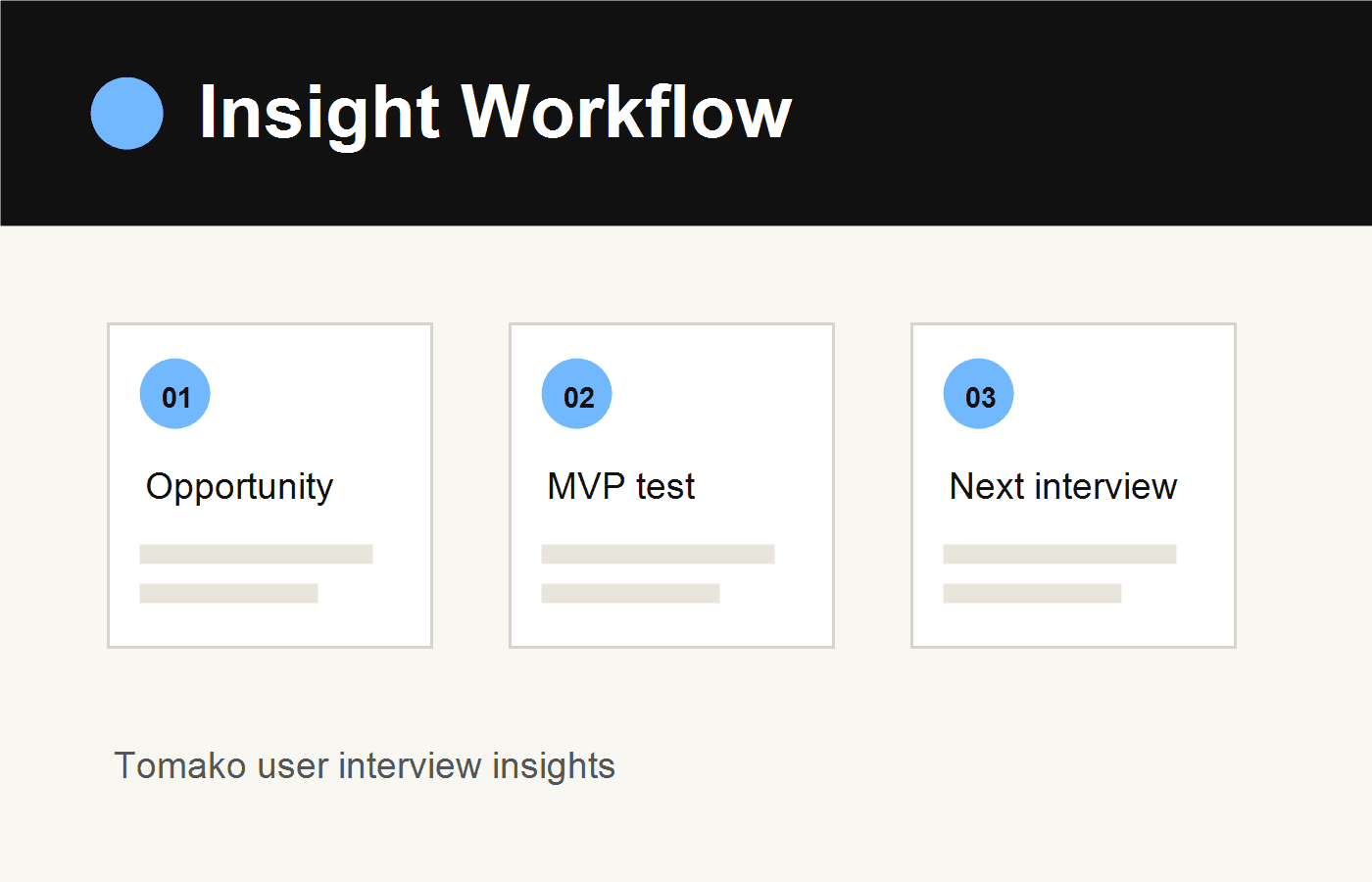
User interview insight report generator interface showing multiple records becoming opportunity maps and experiment plans.

Tool task

User Interview Insight Report Generator

Turn interview notes into a decision-ready research report. The goal is not to summarize every person again, but to find repeated patterns, evidence strength, contradictions, and next actions.

Synthesize multiple interviews into a reviewable insight report

Paste several structured interview records. Tomako uses an Agent to generate theme clusters, pain rankings, opportunity maps, MVP hypotheses, pricing signals, sample limitations, and next experiments.

Multi-interview synthesis

Interview record set

Paste multiple structured interview records. Separate records with ---, Record 1, or blank lines; small-sample output is directional, not conclusive.

Research goal

These details help the Agent understand which product decision the synthesis should support.

What you get

Theme clusters

Group repeated problems, alternatives, trigger moments, and customer language across interviews.
Evidence strength

Separate high, medium, low, and contradictory findings so small samples do not become overconfident claims.

Opportunity map

Turn pains and gaps in current alternatives into product opportunities and priority discussions.

Next experiments

Translate insights into MVP scope, pricing tests, landing-page messaging, or the next interview round.
Best-fit use cases

  • You have at least 3 structured interview records.
  • You need to tell repeated pains from one-off anecdotes.
  • You want to turn interview evidence into MVP scope, pricing hypotheses, or next experiments.
  • You need to explain what the team heard, how strong the evidence is, and what to do next.
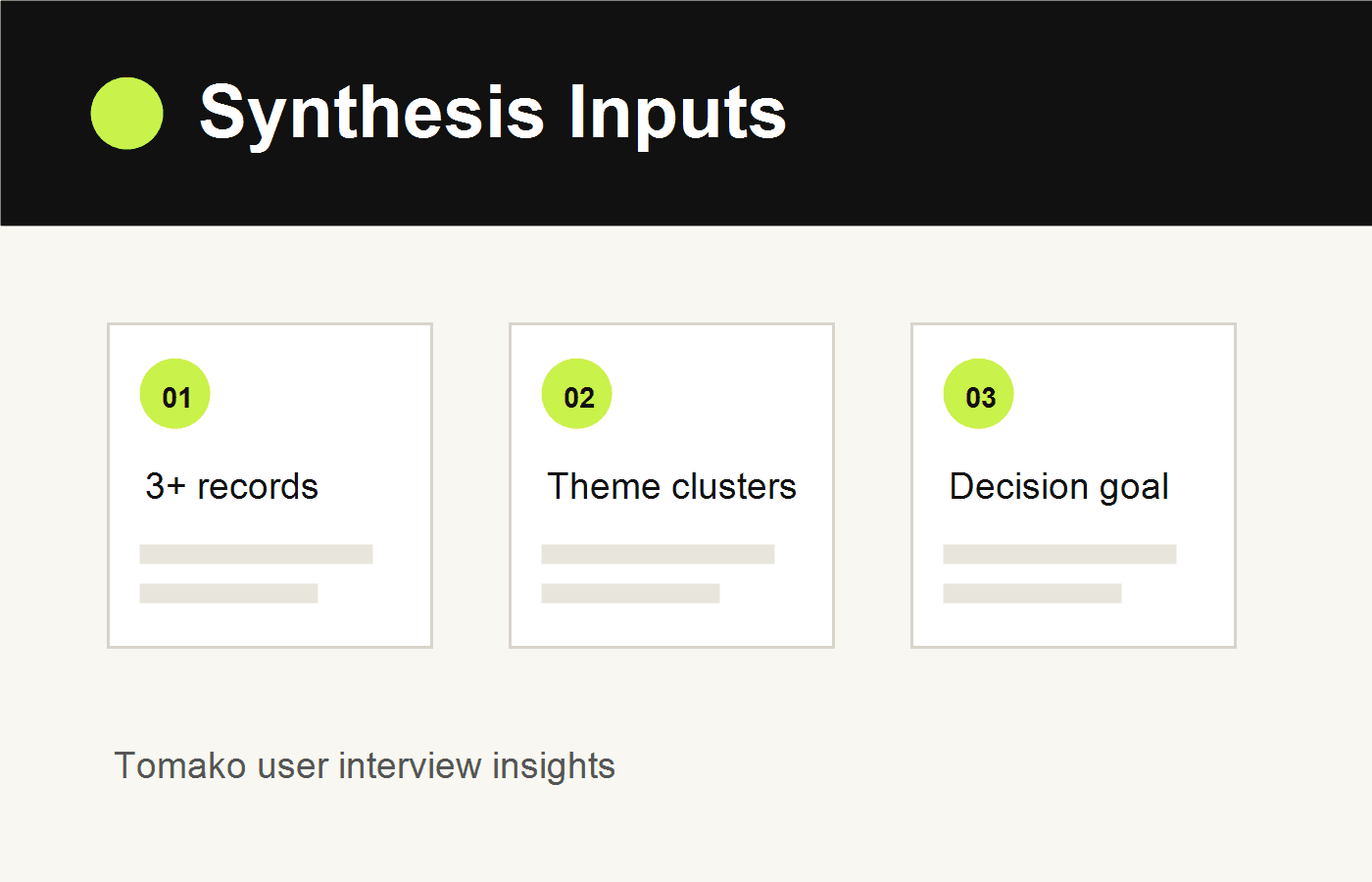
Supported use case visual for the insight report generator, showing multiple records, theme clusters, and product decisions.

What this does not replace

  • It does not replace surveys, behavior analytics, payment tests, or market sizing.
  • It cannot turn 2-3 samples into a definitive market conclusion.
  • It cannot decide that a product is worth building without prototype, conversion, usage, or paid validation.
  • If the records are too short, test text, or cannot be separated, the page blocks submission.

Failure and recovery

  • If task submission fails, your input stays in place so you can add records and retry.
  • If the Agent does not write back a structured result, the page shows the task id for debugging.
  • If the result type or schema does not match, the page will not display a fake success state.
  • When evidence is weak, the result should state sampleLimitations, missingInfo, and reviewChecklist.
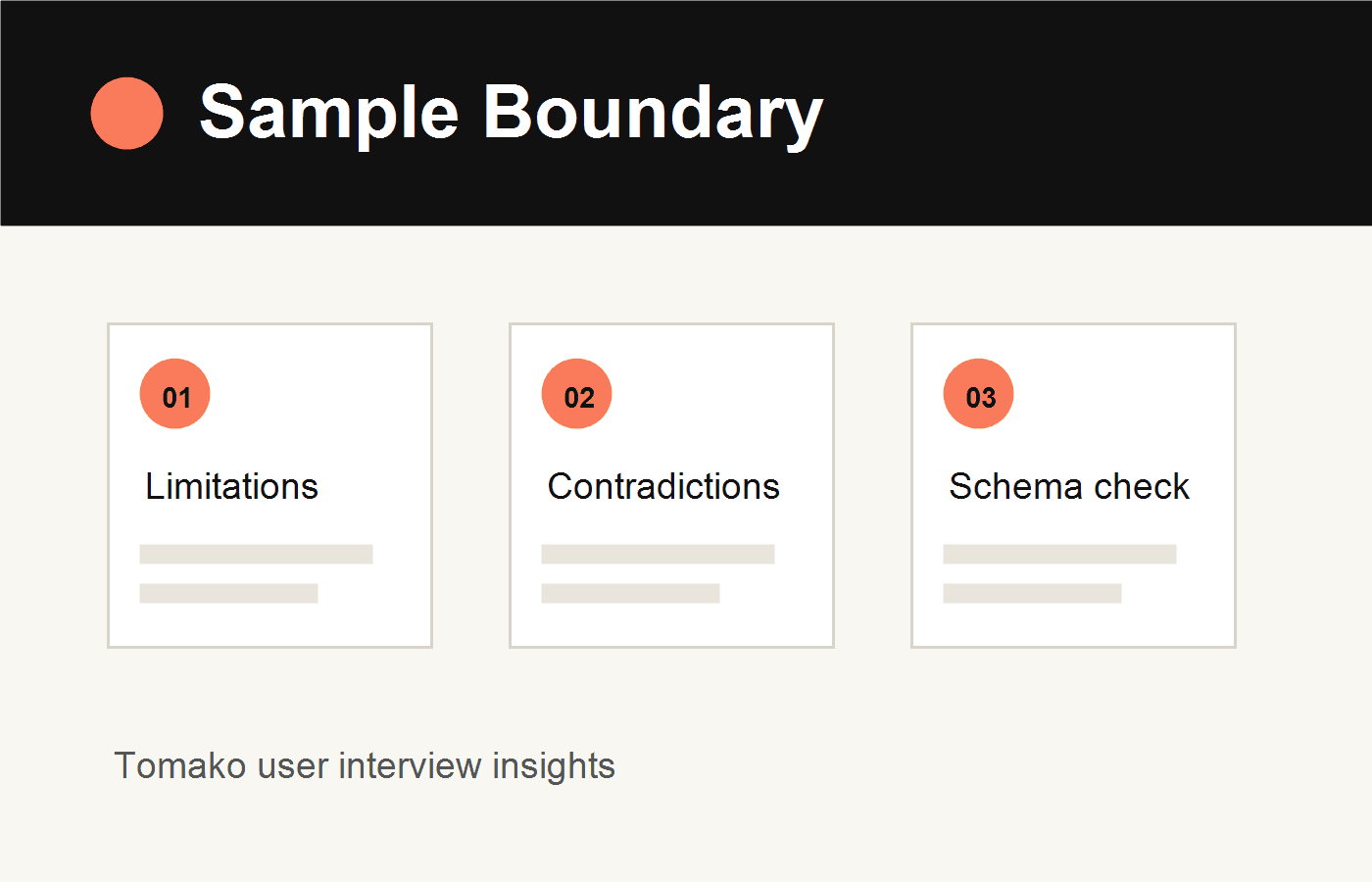
Failure recovery visual for the insight report generator, showing sample limitations, missing information, and schema validation.

How to use the report

  • First check whether every theme traces back to multiple interview records.
  • Keep contradictory findings and sample limits in the decision material instead of cherry-picking support.
  • Turn high-confidence findings into the smallest useful experiment, not a full roadmap.
  • Use missingInfo to plan the next interview round or supporting data collection.
Result usage visual for the insight report generator, showing insights feeding MVP, pricing, and next experiments.

Why use Tomako here

Evidence strength stays visible

The report separates repeated evidence, contradictions, sample limitations, and unknowns.

Connected to product decisions

The output goes beyond summary into opportunities, MVP hypotheses, pricing signals, and next experiments.

Small-sample boundaries

It does not package interview synthesis as statistical certainty; use it for exploration and experiment design.

Less manual clustering

Pains, alternatives, and customer language are organized into stable fields for team discussion.
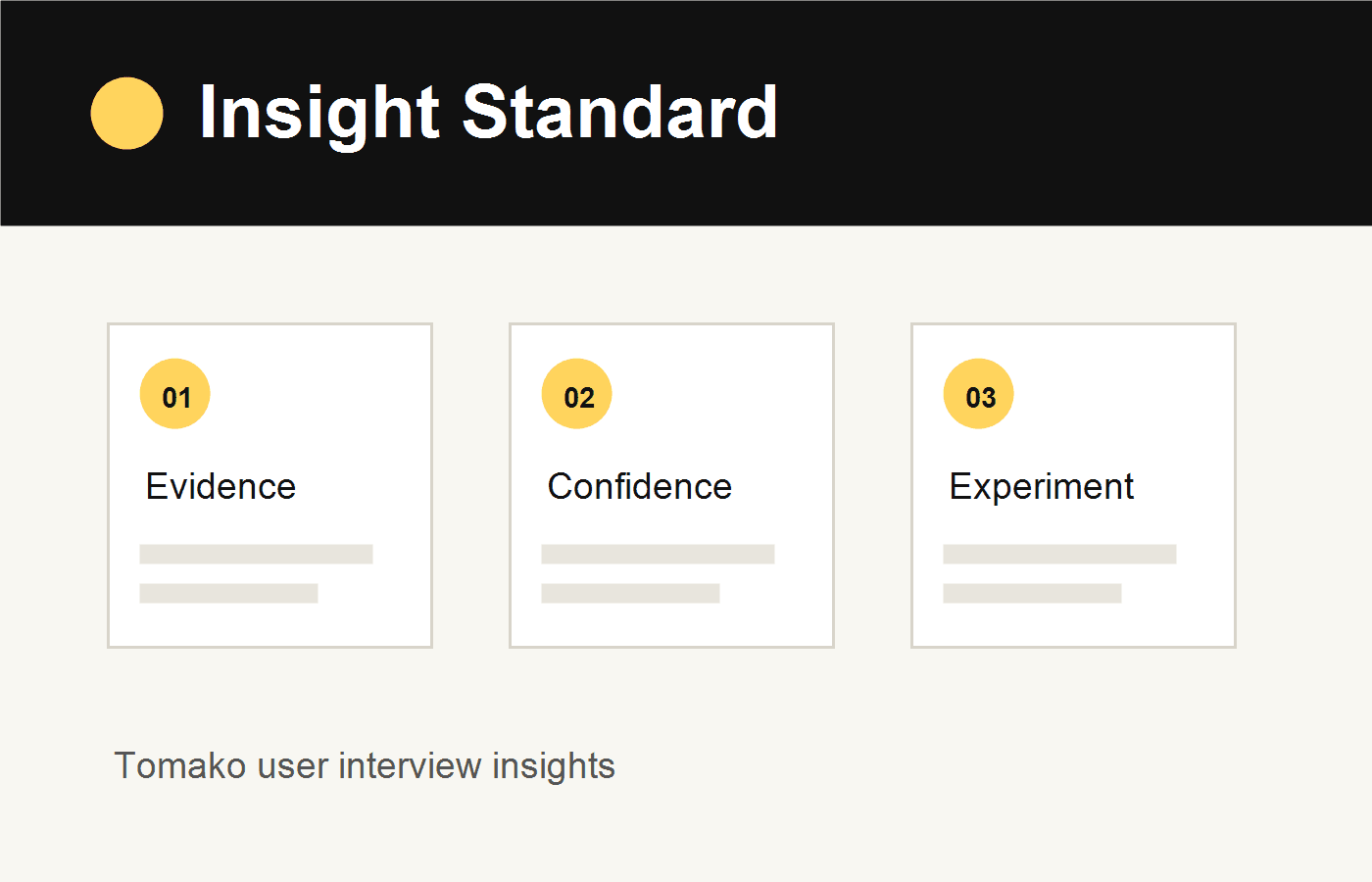
Quality standard for insight reports

  • Every theme should trace back to interview evidence.
  • Contradictions and sample limits should stay visible, not averaged away.
  • Recommendations should become next experiments, not broad roadmaps.
  • The result must be copyable, reviewable, handoff-ready, and tied to a task id.
Quality standard visual for insight reports, showing evidence strength, contradictions, and sample limitations.

FAQ

How many interviews are enough for synthesis?

Three can show early direction; 5-10 are better for repeated patterns. Fewer than three should be labeled as low-confidence direction, not a conclusion.

Does this replace surveys or analytics?

No. Interviews explain why and how things happen; they do not estimate proportions or market size on their own. Use surveys, behavior data, or experiments for that.

Can I follow the MVP recommendation directly?

Treat it as a next experiment design. Strong interview evidence can influence priority, but prototypes, payment, conversion, or usage behavior still need validation.

Does messy record formatting affect the result?

Yes. Synthesis is more reviewable when records separate facts, quotes, inference, and cost. Clean messy transcripts with the single-record tool first.

If you do not have records yet, start with an interview guide; if you have a transcript, structure it first.