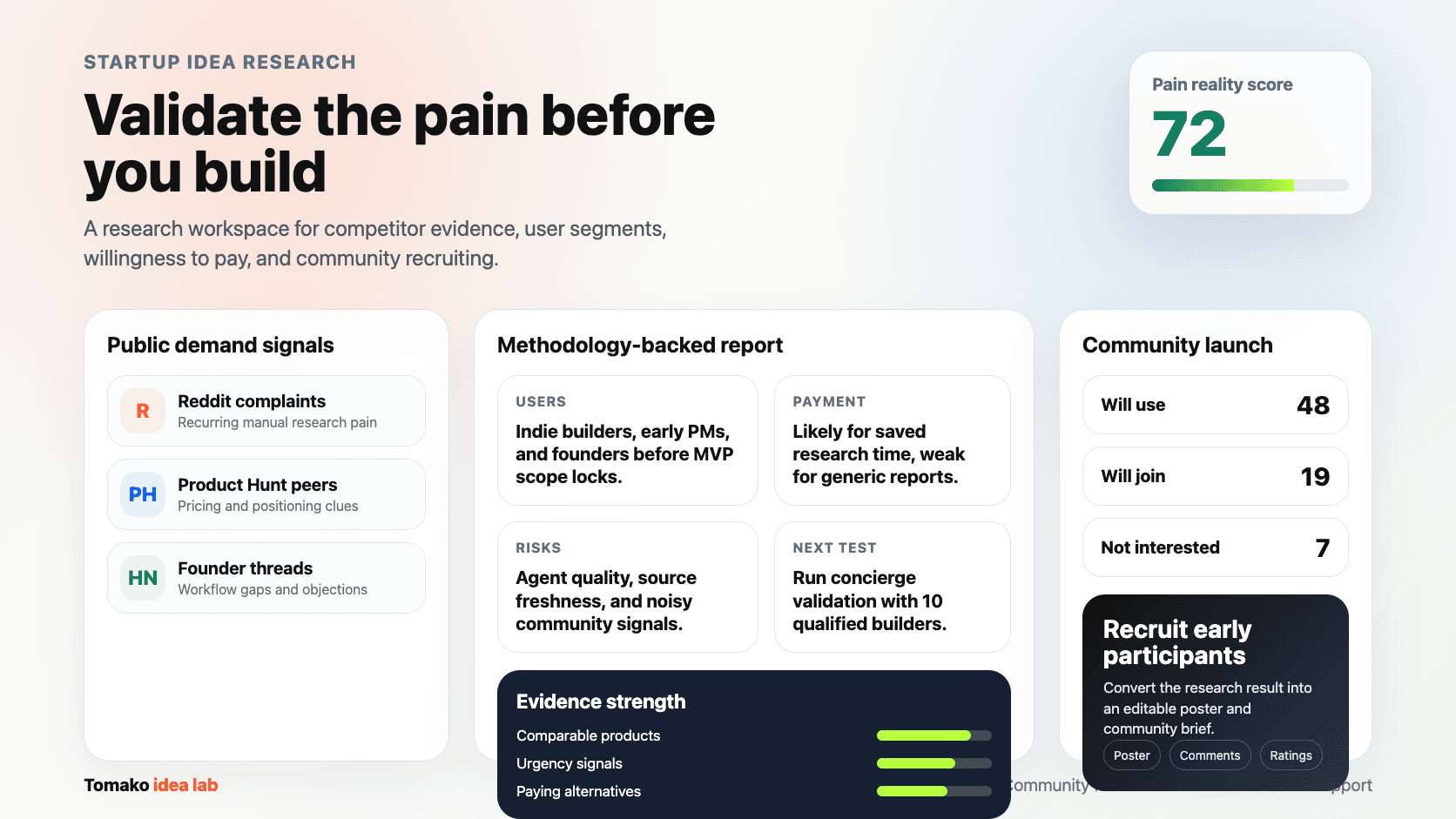
Pain reality verdict: separate strong signals, weak signals, and missing evidence so founder excitement does not masquerade as demand.
Tool task
Startup Idea Research Tool
Turn a rough startup idea into an evidence-aware validation report. The tool checks public competitors and user signals, scores pain reality, segments, willingness to pay, and next experiments, then prepares a community post when you choose to share.
Tool workspace
Enter inputs, review the output, then use the page guidance for the next step.
A rough brief is enough. The agent records missing evidence instead of asking you to write a full PRD first.
The validation report will appear here
The agent will research comparable products and public discussion, then assess pain, users, willingness to pay, and validation experiments.
What you get
Not a pep talk: an evidence map for the riskiest assumptions
Potential user segments: who feels the pain, who has budget, and where they can be reached.
Willingness-to-pay hypotheses: pricing directions based on competitors, alternatives, and current user costs.
Community recruiting draft: when you choose to share, get editable poster prompts and copy to recruit OPC participants.
Good-tool standard
A good idea validation tool proves the problem before polishing the plan
- Evidence first: public discussions, complaints, alternatives, and comparable products before business-plan prose.
- Reviewable conclusions: each key claim should show a source, confidence, or missing-information note.
- Action oriented: the report should lead to interviews, landing pages, payment tests, or community recruiting.
- No inflated promise: it cannot guarantee market size, funding value, or success. It only narrows what to test next.
Result guidance
Use the report to test the most dangerous assumption first
- If pain signals are weak, interview 5-10 target users before building.
- If willingness to pay is mixed, test a pricing page, waitlist, pre-sale, or service delivery offer.
- If competitors are crowded, focus on differentiation and reachable channels instead of feature volume.
- If you share the idea, use community ratings and comments to identify people willing to try or co-create.
FAQ
Boundaries before you use it
Will this tell me whether the idea is worth building?
No final startup judgment. It grades public signals around pain, users, and willingness to pay, then lists assumptions that still need validation.
What comparable product data does it crawl?
The agent prioritizes public websites, pricing pages, launch pages, community discussions, reviews, and searchable material. It does not access private, logged-in, or paywalled pages.
Can I edit before sharing to the community?
Yes. After the report, you choose whether to share. Before publishing, you can edit the title, poster prompt, and explanation copy.
Are community comments and ratings persistent now?
This frontend implements the interaction model and local analytics panel. Production-grade comments, ratings, and permissions require a backend community API.
If the idea already has clear competitors, go deeper on one of them.